
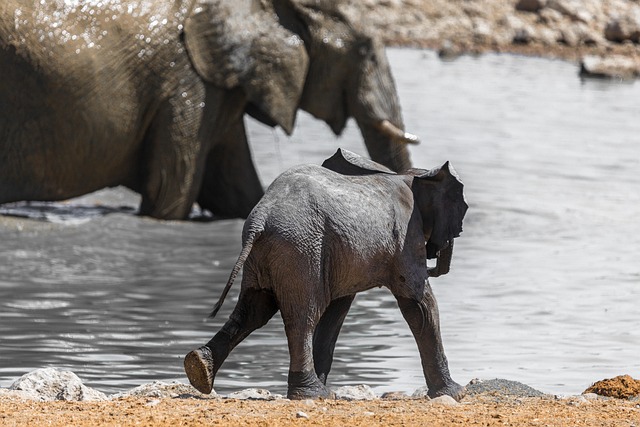
When six-month-old Themba the elephant lost his mother to a cliff fall at South Africa's Sanbona Wildlife Reserve, the odds were stacked against him. For a week, veterinary staff watched and waited, hoping another cow in the herd might adopt the orphaned calf. None did.
"We had originally introduced those elephants to the reserve, so we had already played a significant role in their future," said Dr Johan Joubert, wildlife director at the Shamwari Wildlife Rehabilitation Centre in the Eastern Cape, where Themba was eventually transported. "The decision to intervene and help a little elephant that was clearly suffering was an easy one."
But getting Themba to safety was only the beginning. Baby elephants are profoundly social creatures — experts have long noted that they develop at a pace parallel to human children, and their emotional needs are just as acute. A frightened, grieving Themba charged at anyone who came near. He refused to feed.
The team needed a companion for him. They chose a sheep.
An unlikely introduction
Albert was a full-grown merino, and his first encounter with Themba was hardly love at first sight. The baby elephant charged at the sheep and chased him around the watering hole. Albert fled to a fenced shelter at the far end of the enclosure and stayed there for twelve solid hours.
But Themba was curious. Throughout those hours, the calf kept approaching the shelter, poking his trunk through the fence poles, touching Albert's woolly back and having what filmmaker Lyndal Davies described as "a good sniff."
By the next morning, Albert was bored of hiding. He ventured out — and within hours, the pair were inseparable.
"Themba wouldn't leave Albert's side," recalled Davies, an Australian naturalist who was filming the pair for a documentary and had become the calf's surrogate mother. "The two were seen exploring their enclosure together, with Themba's trunk resting on Albert's back."
More than just company
What developed between them went well beyond simple proximity. Dr Joubert observed that Albert began copying Themba's behaviour — including, remarkably, his diet. "Albert is the first sheep I have ever seen eat a thorny acacia bush," Joubert said. "He has been studying Themba and worked out the best way to get his mouth around the long, sharp thorns to reach the juicy leaves."
The imitation ran deep enough that Joubert described Albert as "like a brother to Themba — an important member of Themba's herd."
Research into interspecies friendships suggests these bonds commonly arise when animals experience stress and the absence of their own kin. According to a Swedish University of Agricultural Sciences study, the most frequently observed behaviours in such bonds are play, social bonding, and sustained physical proximity — precisely what was documented between Themba and Albert.
The late Dame Daphne Sheldrick, the world's foremost authority on raising orphaned elephants, advised the Shamwari team on Themba's feeding. Her decades of work at the David Sheldrick Wildlife Trust in Kenya demonstrated that baby elephants need far more than milk — they need family, contact, and emotional security to survive. Albert, it turned out, provided exactly that.
A legacy of understanding
Shamwari's team had previous experience pairing orphaned animals with sheep — an earlier case involving a baby rhino had shown them how effectively sheep could serve as companions. But the depth of the Themba-Albert bond surprised everyone.
Tragically, Themba died in February 2010 from an intestinal torsion — a rare and virtually untreatable condition — just as the team was preparing to reintroduce him to the wild. He was two years old. The loss devastated staff and the millions worldwide who had followed his story through the Animal Planet series Shamwari: A Wild Life.
Yet what Themba and Albert demonstrated endures: that the capacity for comfort, companionship, and genuine emotional connection is not confined to a single species. Sometimes, when the world falls away, a woolly back and a curious trunk are enough.