
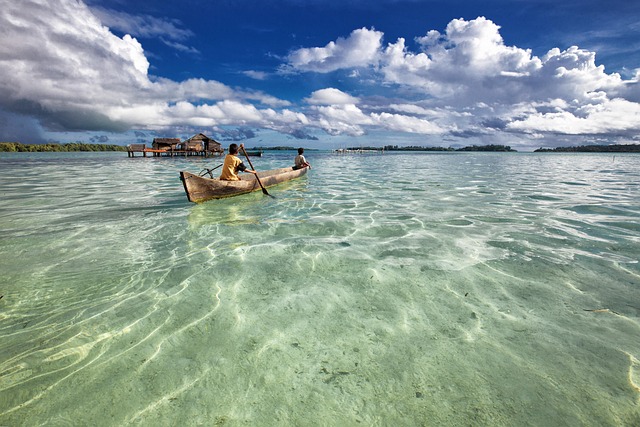
On a slender ribbon of coral in the west-central Pacific, a small nation is doing something rather extraordinary. Tuvalu is, quite literally, making more of itself.
While much of the world frets about rising seas in the abstract, the 6,000 or so Tuvaluans on the frontline have set about a remarkable feat of engineering: they are dredging sand from the lagoon floor and building entirely new land — ground designed to stay above the waves well beyond the year 2100.
The Tuvalu Coastal Adaptation Project, run by the country's government with support from the United Nations Development Programme (UNDP) and the Green Climate Fund, has so far created more than seven hectares of new land, UN News reports. A second phase, begun in 2024, will add another eight hectares along the southern shore of the capital, Funafuti, where six in ten Tuvaluans live.
How you build a country
The method is straightforward to describe and astonishing to behold. Sensors map the seabed in fine detail. Dredgers haul sand up from the lagoon. The sand is then deposited and shaped into raised platforms — high enough, in theory, to remain dry as the ocean continues to rise. On these new shelves of earth, families can build homes, schools, and the everyday architecture of a life.
"These are very drastic measures," Tuya Altangerel, a senior UNDP official in the Pacific, told UN News. "We basically rebuild the land around the atolls so that there is safe land where people can build shelters, housing." The cost so far is close to $55 million.
A creeping tide, not a single wave
That such measures are needed at all is sobering. In Tuvalu, the sea has risen 21 centimetres in 30 years — nearly twice the global average. Some projections suggest 95 per cent of the country could be underwater by 2100.
The greatest threat is not a single dramatic flood but the relentless creep of high tides, which now wash over sea walls and even, Ms Altangerel said, swallow the mangroves planted to hold them back. "Our islands are drowning," she told UN News.
Determination, not despair
What is striking about Tuvalu is not the despair but the determination. In 2022, the government created the world's first "digital nation" in the metaverse, archiving its statehood and culture against the worst. In 2023, it signed the Falepili Union with Australia, allowing 280 Tuvaluans to relocate each year — and last year, more than 90 per cent of the population applied for the first ballot.
An International Court of Justice ruling in 2025 confirmed that even should the islands one day vanish, Tuvalu would remain a nation: with its seat at the UN, its sovereignty, and its rights over its ocean resources intact.
But for those who remain — and most do — the question is not how to leave well, but how to stay. A new insurance scheme in Funafuti pays up to $1,500 to an initial 400 households for each high-tide event. There is language, there is song, there are the ordinary rhythms of island life. There is, above all, the stubborn human business of being from somewhere.
"It's not just about coastal areas disappearing," Ms Altangerel said. "It's also the people's sense of nationhood and the future existence of these countries that are very much under threat."
A template for the Pacific
If the project succeeds, it will offer more than safe ground for one small country. Tuvalu, Kiribati and the Marshall Islands are three of the four lowest-lying nations on Earth, and what works on Funafuti's shoreline could, in time, be replicated across the wider Pacific and beyond.
Seven years ago, on a visit to the region, the UN Secretary-General António Guterres put it plainly: "If we save the Pacific, we save the world."
In Tuvalu, they have begun.