

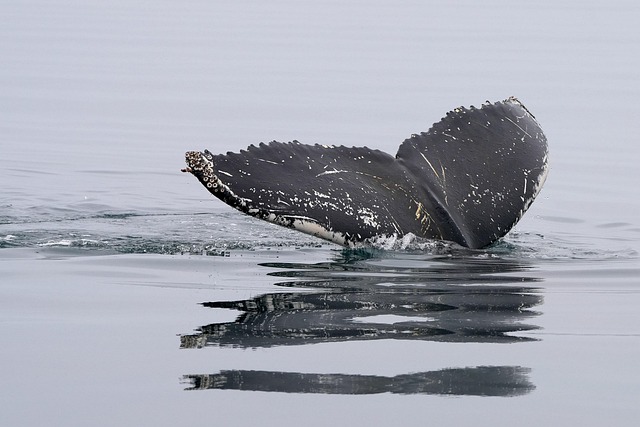
When 55 long-finned pilot whales came ashore on the Isle of Lewis in July 2023, it was the largest mass stranding recorded in Scotland in living memory. Now, almost three years on, scientists at the University of Glasgow have pieced together a crucial part of what the whales had been doing in the weeks before they died.
Their answer lies in chemical clues preserved in the animals' skin — and a technique called stable isotope analysis that has, for the first time, revealed where Scotland's pilot whales feed before they strand.
The new study, led by the Scottish Marine Animal Stranding Scheme (SMASS) at the University of Glasgow and published in the journal PLOS One, drew on tissue samples from all 55 of the Lewis whales. The research found that in the weeks before the stranding the pod had been feeding along the continental shelf edge and slope — deep, offshore waters known to support rich populations of fish and squid in spring and early summer.
It is the first direct evidence that long-finned pilot whales rely on these shelf-slope habitats as seasonal feeding grounds. The proximity of those waters to rapidly shallowing coastlines, the Glasgow team say, may itself be a risk factor — placing foraging animals close to the conditions that lead to stranding.
A chemical diary
Stable isotope analysis works a little like reading a diary written in a whale's own body. As an animal eats, the chemical fingerprint of its prey is locked into its tissues. By measuring the ratio of carbon and nitrogen isotopes in skin samples, scientists can reconstruct what the animal had been eating, and broadly where, in the weeks before its death.
For deep-diving species such as pilot whales — notoriously difficult to study in the wild — the technique offers a rare window into an otherwise hidden life.
"Understanding the feeding habits of large marine predators such as long-finned pilot whales is critical for the development of conservation strategies. However, dietary data are often lacking," said lead author Anna Kebke, a PhD researcher at the University of Glasgow.
"Our findings demonstrate the importance of deep-water food sources to long-finned pilot whales, providing valuable insights into their early spring-summer feeding habits. These results highlight the value of stable isotope analysis in advancing our understanding of cetacean trophic ecology and better informing marine mammal conservation management."
A pod that followed a struggling mother
Post-mortem examinations carried out by SMASS in 2023 found the whales had been in good health. A subsequent Scottish Government investigation concluded that the highly social pod appeared to have followed a female experiencing a difficult birth into dangerously shallow water.
What the new Glasgow research adds is the missing chapter before that final, fatal turn inshore. Although the animals were well nourished, their stomachs were empty — raising fresh questions about their foraging in the days immediately before the stranding.
Dr Andrew Brownlow, Director of SMASS, said the two strands of work complement each other.
"Post-mortem examination tells us about the animals' condition at the moment of stranding; stable isotope analysis tells us where they had been and what they had been eating in the weeks before," he said. "Together, they allow us to move from asking what happened at the moment of stranding to asking what set these animals on a course towards it."
Why it matters now
Two further pilot whale mass strandings have occurred in Scottish waters since the Lewis event, in 2024 and 2025 — a pattern that has lent new urgency to the Glasgow team's work.
Mapping where these elusive animals feed, and how those patterns may be shifting as the marine environment changes, is essential, the researchers say, to understanding how human activity affects the species and to designing strategies that could help prevent future strandings.
The work was supported by the Natural Environment Research Council, the Joint Nature Conservation Committee, and Portugal's Fundação para a Ciência e Tecnologia.