
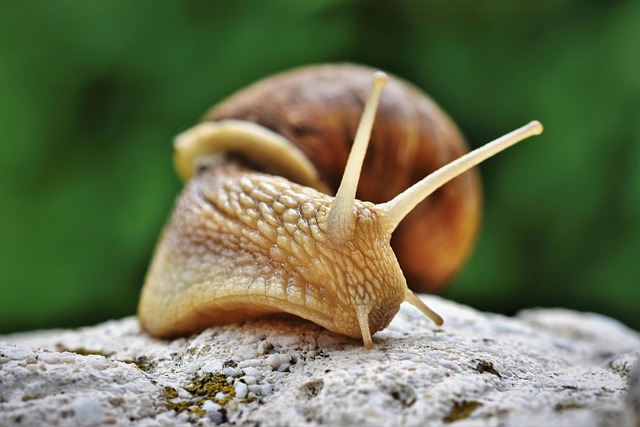
It is not every day that a discovery is this small, or this tidy. In the limestone mountains of northern Montenegro, scientists have found two new snail species that can pull up the drawbridge behind them: each carries a small circular disc on its tail that seals the shell opening like a door when the animal retreats inside.
The snails, named Cochlostoma komarnica and Cochlostoma dobrido, have shells about 6 millimetres long, according to the release from the publisher Pensoft. That is small enough to sit on a fingernail. Their shells are cone-shaped, and they live on limestone rocks, where they feed on algae and lichens.
They have another party trick. Unlike most land snails, their eyes sit along the sides of the head rather than on the tips of eye stalks. It is a fine look for an animal that, until now, nobody had noticed.
Found by people who turned up to help
The species were described in a study published on 27 July 2026 in the open-access journal Biodiversity Data Journal. The lead author is Menno Schilthuizen of Taxon Expeditions and Naturalis Biodiversity Center in the Netherlands.
The snails came out of fieldwork organised by Taxon Expeditions, an initiative that lets members of the public take part in real scientific research. Between 2018 and 2025, expeditions in Montenegro brought together international researchers, citizen scientists, local students and conservationists. The partnership involved Taxon Expeditions, the non-profit Taxon Foundation and the Montenegrin Ecologists Society (MES). Their task was to survey the wildlife of Durmitor National Park and Komarnica Canyon.
The snails turned up at several sites, but it was not obvious that they were something new. That became clear only after the animals were dissected and genetically analysed in the team's field laboratory.
The names were settled by a vote at camp. Cochlostoma dobrido honours the Dobri Do Plateau among the peaks of Durmitor National Park. Cochlostoma komarnica takes its name from Komarnica Canyon, which lies south of Durmitor.
Among those who took part was Janine Buisman, a musician from the Netherlands who joined an expedition and later became a co-author of the paper. “I was amazed that it is still possible to discover new animal species in Europe,” she said.
A canyon with a question mark over it
The discovery also lands in the middle of a live debate. Biologist Jovana Đokić of MES, another author of the study, says the canyons, mountains and gorges of this part of the Balkans hold extensive biodiversity that remains poorly explored.
That is why plans affecting Komarnica Canyon worry her. “It is all the more worrying that the Komarnica Canyon is targeted to be flooded by a hydropower dam and reservoir,” she said. “This will destroy this wild river canyon and all the biodiversity in it, including many species still unknown to science.”
The proposed development has helped make the canyon a focus for organised biodiversity surveys. Researchers and conservation groups are documenting its wildlife to build a scientific case for protecting it. MES is calling for Komarnica Canyon to be added to the UNESCO World Heritage site of Durmitor, and for the hydropower plans to be abandoned. “Hydropower is neither green nor sustainable energy when it destroys a unique ecosystem like this,” Đokić said.
The canyon currently lies outside the boundaries of the UNESCO-listed park. Dr Amelie Huber, Freshwater Project Manager at the conservation group EuroNatur, said the find “is a powerful reminder that the natural treasures of the Balkans are far from fully explored”. She added: “Once a unique ecosystem is lost, we risk losing species before science has even had the chance to document them.”
Small animals, big argument
The two snails will not settle the future of a canyon by themselves. But they show how much can turn up when scientists, students and enthusiastic volunteers spend time in a place that has barely been surveyed.
Neither species has an English common name yet. Suggestions, presumably, are welcome.
The study, “Two new Cochlostoma species from the Durmitor and Komarnica regions of northern Montenegro (Caenogastropoda, Cochlostomatidae)”, is published in Biodiversity Data Journal (2026, volume 14, DOI 10.3897/BDJ.14.e196955). Additional reporting from a Pensoft release carried by ScienceDaily and a release from the Save the Blue Heart of Europe campaign.